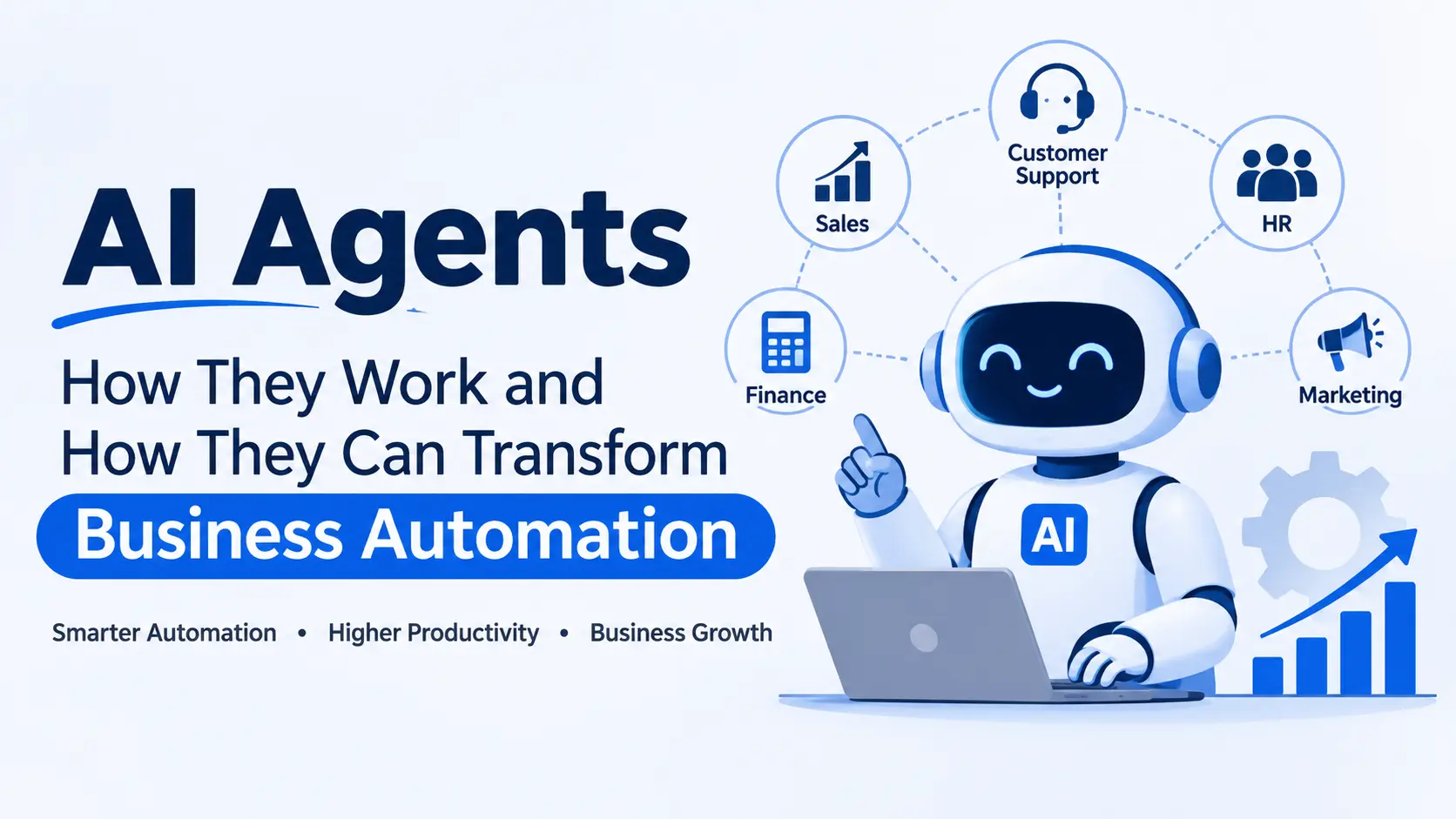
AI Agents: How They Work and How They Can Transform Business Automation
Running a business involves many tasks that take time but don’t always require human decision-making. Responding to customer inquiries, updating CRM records, processing information, following up with leads, and managing routine operations are just a few examples. When these activities are handled manually, employees have less time to focus on work that actually helps the business grow.
This is where AI Agents can make a difference.
AI Agents are changing how businesses approach automation. Instead of simply following predefined instructions, they can understand requests, decide what needs to be done, use different tools, and complete tasks based on a specific objective. But what exactly are AI Agents, how do they work, and where can businesses use them?
What Are AI Agents?
An AI Agent is a software system that uses artificial intelligence to understand a goal and take actions to achieve it. It can process information, make decisions, interact with external applications, and handle tasks with limited human involvement.
Think about a customer who wants to know when an order will arrive. A basic chatbot might provide general information or ask the customer to contact support. An AI Agent can connect to the company’s order management system, retrieve the latest delivery status, and provide an accurate response.
If there is a delivery problem, it may also create a support ticket or notify the relevant team, depending on its permissions.
This is the main difference between answering a question and completing a task. You can learn more about AI Agent development and its business applications on Coderrex.
How Do AI Agents Work?
An AI Agent works through a combination of an AI model, instructions, available tools, and business data. Although the implementation can vary, most agents follow a similar process.
1. Understanding the Request
Everything starts with a goal. A user might ask the agent to find new customer inquiries, check pending orders, or prepare a sales report.
The AI model processes the request and identifies what needs to happen.
2. Planning the Next Steps
Once the objective is clear, the agent determines how to approach the task. It may divide a larger request into smaller steps and decide which tools or information sources are required.
For example, preparing a sales report might involve retrieving CRM records, checking payment information, and organizing the results.
3. Connecting with External Tools
An AI Agent becomes more useful when it can interact with existing business applications.
Through APIs and tool calling, it can connect with CRM platforms, databases, email services, payment systems, and other software. This allows the agent to retrieve information or perform permitted actions instead of simply generating text.
4. Performing and Checking Actions
The agent carries out the selected actions and checks whether they produce the expected results. If something is missing, it may request additional information or try another available approach.
For sensitive operations, businesses can require human approval before the agent proceeds.
5. Delivering the Result
After completing the task, the agent communicates the outcome, updates the relevant system, or sends the request to a human employee if further attention is needed.
How AI Agents Can Help Businesses with Automation
AI Agents are useful in situations where employees regularly perform similar tasks across multiple applications. Here are some practical examples.
Customer Support
Customer support teams often spend hours answering similar questions. An AI Agent can retrieve information from company systems, respond to common inquiries, check order details, and create support tickets.
Businesses can also combine agents with AI chatbot solutions to provide customers with a convenient way to interact with automated support systems.
Sales and Lead Management
Following up with potential customers is important, but it can become difficult when a business receives hundreds of inquiries.
An AI Agent can collect lead information, identify potential customers based on predefined criteria, update CRM records, and prepare follow-up messages. Sales representatives can then concentrate on conversations that require personal attention.
HR and Recruitment
Recruitment involves reviewing applications, organizing candidate details, and scheduling interviews. AI Agents can help HR teams collect relevant information, compare applications against job requirements, and coordinate interview schedules.
Final hiring decisions should remain with qualified people.
Finance and Invoice Processing
Finance departments handle invoices, payment records, and routine verification tasks. AI Agents can extract information from invoices, compare records, identify missing details, and prepare payment requests for approval.
This can reduce repetitive data entry and help teams identify issues earlier.
Marketing and Business Operations
Marketing teams can use AI Agents to research topics, organize campaign data, prepare reports, and assist with customer communication.
Similarly, businesses can automate internal workflows such as collecting employee requests, updating records, and notifying the right department.
Technologies Used to Build AI Agents
Building an AI Agent usually requires several technologies working together.
- Large Language Models (LLMs): Help agents understand instructions, process information, and decide what to do next.
- Prompt Engineering: Defines the agent’s responsibilities, instructions, and operating boundaries.
- APIs and Tool Calling: Allow agents to communicate with external applications and perform actions.
- RAG (Retrieval-Augmented Generation): Helps agents retrieve relevant information from company documents and knowledge sources before responding.
- Vector Databases: Store information in a format that supports semantic search and retrieval.
- MCP (Model Context Protocol): Provides a standardized way for AI applications to connect with external tools and data sources.
For businesses that need AI systems to work with internal documents, policies, or product information, RAG application development can be an important part of the solution.
Frameworks such as LangChain and development technologies like Python and FastAPI can also help developers build, integrate, and manage AI-powered applications.
Things to Consider Before Implementing AI Agents
AI automation is not something businesses should introduce without proper planning. An agent may misunderstand a request, retrieve incorrect information, or perform an unintended action if its instructions and permissions are not configured correctly.
Start with a clearly defined business process rather than trying to automate everything at once. Give agents access only to the information and tools they actually need. Monitor their activities, protect customer data, and require human approval for important financial or business decisions.
It is also worth measuring the results. Time saved, fewer manual errors, faster response times, and improved customer experiences can help determine whether an AI Agent is delivering real value.
Final Thoughts
AI Agents are creating new opportunities for businesses to handle everyday operations more efficiently. They can do more than answer questions: they can retrieve information, work with existing software, and complete multi-step tasks based on business requirements.
However, successful automation is not about replacing every manual process with AI. It is about identifying where intelligent automation can genuinely help employees and customers.
Businesses that start with practical use cases, reliable integrations, and appropriate human oversight can build a strong foundation for using AI Agents in their daily operations.
Frequently Asked Questions (FAQs)
1. What is the difference between an AI Agent and an AI Chatbot?
An AI Chatbot primarily focuses on communicating with users and answering questions. An AI Agent can go further by using external tools, accessing business systems, making decisions, and performing tasks. Some advanced chatbots also include agent capabilities.
2. Can AI Agents automate business processes without human involvement?
Yes, AI Agents can handle certain repetitive processes independently when they have the required instructions, permissions, and system integrations. However, businesses should keep human supervision for sensitive activities such as financial transactions, hiring decisions, and important customer account changes.
3. How much does it cost to develop an AI Agent for a business?
The development cost depends on the complexity of the automation, the AI model, the number of integrations, data requirements, security measures, and ongoing infrastructure. A simple customer support agent generally requires fewer resources than a multi-agent system connected to several enterprise applications. Businesses should first define their requirements to estimate the development cost accurately.